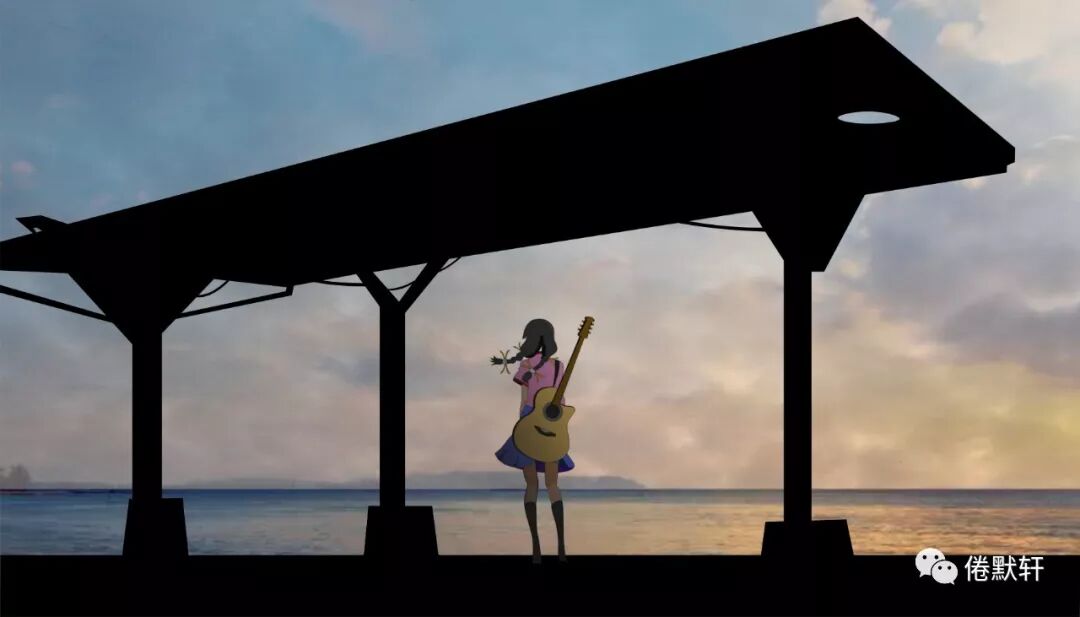
Water has no color, no taste, no smell; no form, no feature, no voice. It takes its shape from whatever banks contain it, flowing on without ever going stale; it does not pick between high ground and low, gentle, contending with nothing. From Confucius in the Spring and Autumn age, musing that “the wise delight in water, the humane delight in mountains” (知者乐水,仁者乐山), to Guo Linzong of the Eastern Han, who praised a depth of character that “settled, will not clear; stirred, will not muddy,” to Wei Huanxi of the Qing, sighing that “the gentleman is like water, the small man like oil” — down all the ages, water has stood as the emblem of wisdom, of measure, of virtue, and been charged with more humane meaning and aesthetic depth than perhaps any other thing. And the summit of it all is surely the exchange between Confucius and his student Zigong set down in the Xunzi:
Confucius stood contemplating water that flowed toward the east. Zigong asked him, “Why is it that the gentleman, whenever he sees great waters, must pause to contemplate them (君子见大水必观焉)?” Confucius said: “Because water is great: it gives itself everywhere to all that lives, and does so without design — in this it is like virtue. In flowing it keeps to the low places, and through every bend and check it follows the line of its inevitable course — in this it is like righteousness. Full and surging, it is never drained dry — in this it is like the Way. If a channel is cut and it is set loose, it answers swift as an echo, and it hurls itself into gorges a hundred fathoms deep without fear — in this it is like courage. Called to be the measure, it is always level — in this it is like law. It fills a vessel and asks for no leveling-stick — in this it is like rectitude. Delicate and yielding, it works its way into the finest crevice — in this it is like discernment. Whatever goes into it and comes out of it emerges fresh and clean — in this it is like the transforming power of good teaching. And through ten thousand turnings it holds always to the east — in this it is like will. That is why the gentleman, whenever he sees great waters, must pause to contemplate them.”
Small wonder that Confucius is honored as the Supreme Sage and First Teacher, the Model for Ten Thousand Generations. His meditation on great waters, as the Xunzi gives it, spans well-nigh every plane of the culture of water — a whole forest of correspondences, nothing left out. In the Master’s eyes, water rolling on vast and unbounded is virtue bestowing its bounty on all things; winding through nine bends, it is moral order making its circuit of the four quarters; surging and clamoring, it is courage that never once turns back; lying flat as a mirror, it is law holding the balance and steadying the axis; reaching into every least crevice, it is Heaven’s gaze searching the world; rinsing all things clean, it is teaching that quickens custom and braces morals; flowing east into the sea, it is a will that no hundred bendings can break…
Open the canonical books of Chinese culture and you find that nearly every record and document is steeped in the lore of water; the describing, chanting, and singing of water has been, under the brushes of generation upon generation of poets and men of letters, a literary motif the ages have never worn out and a cultural self-recognition forever renewed — and this is no square tenon rammed into a round mortise, no wisdom solemnly read into a slip of the pen. From the Airs and Odes and the plaints of Chu, through the rhapsodies of the Han and the ballads of its Music Bureau, on to the airs of the Tang, the cadences of the Song, and the shifting currents of the Ming and Qing, there is scarcely a line that does not, in painting feeling or sketching mood, take its impetus from water, speak its aspirations through water, carry its emotion by water, borrow its cadence of water: here the entangled longing of “Thick grow the reeds and rushes, the white dew turns to frost; the one whom I call beloved stands somewhere across the water”; there the homesick ache of “Still I love these waters of my native land, that follow my boat ten thousand li to see me off”; here the thwarted plaint of “I would ride a raft into the southern sea, but the sea is too vast to draw near”; there the grief for a fallen house and kingdom of “Ask how much sorrow one heart can hold — just as much as a river of spring water flowing east”; and here again the philosopher’s question of “A hundred rivers run east to the sea; when shall they ever turn west again?”… Knocking at the classics and questioning the histories, going on pilgrimage to the mountains and paying court to the waters, tracing the arcs that the white robes of the sages of old cut as they danced through the dust-haze of history, I seem to see those figures that have ridden through a thousand years standing immovable on the summit of culture, stroking their beards among the hills and streams, and smiling.
To put it in a word, the meaning of water in Chinese culture is luminous and limpid yet dim and elusive: gaze at it before you and all at once it is behind you; draw near and it seems yours, clasp hands and it is already gone — exactly as Hanshan wrote, “A faint breeze breathes through the secluded pines; the nearer you listen, the finer the sound.” As the distance between you and the secluded pines closes, you walk in among the trees, you walk into the sound of the wind; and little by little you are a thread of breeze passing through, you are a pine letting the breeze pass over you. To my mind, the wisdom of flowing water is a Zen understanding pure and unstained, warm and rounded and whole; a breadth of spirit that meets every change unstartled and moves as circumstance moves; a lamp of insight that cuts its own valley through the hills, sure as spring swallows crossing on the wing.
Eileen Chang once said that life is a gorgeous robe crawling with lice; Qian Zhongshu observed in his turn that the phrase “happy forever” is not merely too remote ever to be attained, but too absurd even to stand. The China before our eyes can be summed up in eight characters: the clash of old and new, the collision of East and West — the clash of old and new cultures, the collision of Eastern and Western values. Between one person and the next hangs a harsh air of restless desire, of money worshipped and profit chased; those who cling to the mighty for their rise swarm like ants to rancid mutton, like flies after a stench; and the reigning common sense of society is as pitiless as the law of the dark forest set out in The Three-Body Problem. Confronted with the numberless neon nights and gilded stupors along the way, people find their bewilderment and their losses growing in direct proportion to their gains. To live as water lives sounds occult and unfathomable; in truth it is not out of reach. Water excels at benefiting the ten thousand things yet contends with the world for nothing. Among the five elements it has none of metal’s dazzle, wood’s tall bearing, fire’s ardor, or earth’s solid weight, and yet it can cool the scorching metal, bear up the wooden ship on its voyage, quench the roaring blaze, and moisten the wide expanse of the land. The gentleman ought to take his rule from water and pursue it untiring: to take things up and to set them down, never forgetting the heart he began with — for only so does one see the way through to its end.
Set aside the endlessly exalted planes of the spirit: politics too can draw nourishment from the culture of water. The Guoyu says: “To stop the mouths of the people is more perilous than to dam a river. When a dammed river bursts, those it wounds are sure to be many; and so it is with the people.” When Tang Taizong debated the art of governing with his ministers, he too returned again and again to the maxim that water can carry the boat, and water can overturn it (水能载舟,亦能覆舟). You have only to look: down the ages, how many officials, while they still stood far off among the rivers and lakes, were forever airing grievances and arraigning the ills of the day, grandly promising themselves to sweep the age clean and set the world to rights — and then, once they shot up the blue sky at a stride and took their seats in the temple halls of state, the breath came easier, the words came no more, and they minded nothing but the quiet enjoyment of rank and honor, like a mountain brook that, once it joins the great river, loses the clear, ringing note it had among the hills. Look back at the political climate of the present day: with some officials “the stemmed glass is raised more often, the big bowl of tea drunk less” — the higher the office climbs, the farther the heart drifts from the people. Let those who sit in the halls of state carry the people in their hearts, and the people will as a matter of course bear them up in their hands; but where the people’s feeling and will are not followed, their livelihood and good not bettered, their worries and hardships not eased, then “love deep as fish and water” turns into “fire and water, never to share the world.”
If we lower our gaze from the clouds of the spirit and look down upon water in its natural and its social aspects, then water is the source of life, the mainstay of production, the foundation of every ecology. How to guide it as its own momentum directs, courting the benefit and averting the harm, so that rivers run open and waters run free, and stream and lake keep their calm? The answer speaks for itself: water conservancy. Then what is water conservancy, truly?
Water conservancy is by no means merely certain structures on the plane of engineering, a stock of techniques for wrestling with the forces of nature; nor is the study of it a matter of soaking in blueprints and parameters, lost in the rigid routine of structural calculation, while the culture behind the water is cast off like a worn-out shoe — all the wooden, tongue-tied dullness of the stock engineering man. True water conservancy takes water to benefit: to benefit the heart, to benefit this world, to benefit the people who live in it — letting flower the rounded music of water that belongs to those who serve it, and the proud spirit of a culture handed on from torch to torch.
Wang Tingxiang, thinker of the Ming, said: “Sink the mind in long deliberation to reach what is fine and subtle; observe each thing as it comes to prove how all runs together; roam at ease and nourish the spirit until the truth is your own.” The subtle grasped, the connections proven, the truth made one’s own — in the water conservancy man of my ideal, life and learning should be fused in just this way into one thing, whole as if made by nature. When the light of the culture of water wraps the solid palace of engineering from without, that air of rounded unity will pierce every obstacle and reach the very core of the age.
This, and nothing less, is the cultural meaning of water conservancy — the very soul of the culture of water.[1].
[1].At the time of writing, the author was a student of the 2018 class in the Department of Water Conservancy at Shandong University; the original was first published on the school’s official website.